
Kids' Hearing Protection · Buyer & Parent Guide
How to Choose Kids' Earmuffs: Safety, Fit, Sensory & School
A child's ears are more vulnerable than yours, and the pair that protects them is the pair they'll keep on. Here's how to choose the right rating, the right fit and the right certifications — for events, the classroom and sensory needs.
What to look for, in 30 seconds
- Rating: aim for SNR 25–30 dB (about NRR 22–27) for most kids. Higher isn't better — a child still needs to hear your voice and safety calls.
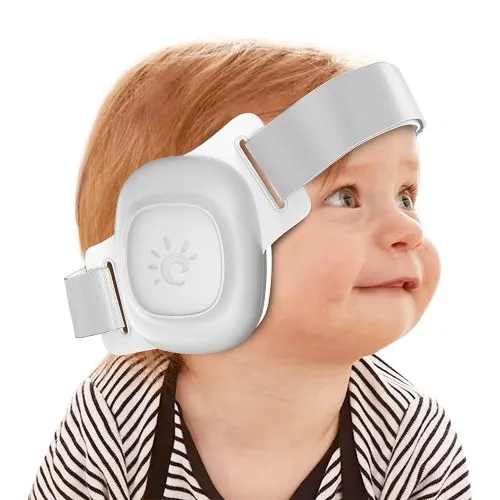
- Fit beats numbers: a comfortable muff a child keeps on protects more than a high-rated one they pull off. Look for light weight, a band that adjusts as they grow, and cup depth that clears the ear.
- Safety certs: for children's products, look for EN 71-3 (no harmful chemicals) plus a CPC/CPSIA for the US; EN 352-1 covers the hearing-protection side.
- Sensory needs: for autism or SPD, put soft cushions, lower clamping force and a design the child likes ahead of the highest dB number.
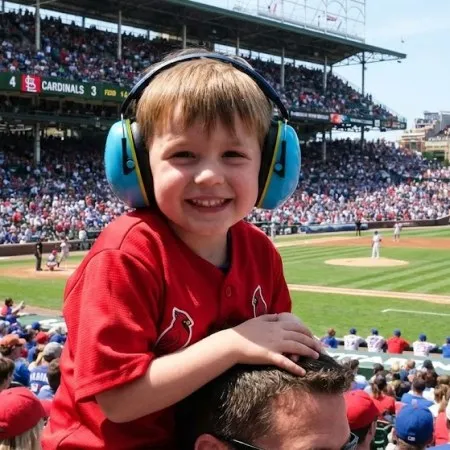
Modern events are loud. A football stadium can reach around 115 dB, and the crowd-roar record at Arrowhead Stadium hit 142.2 dB — about the level of a jet engine at takeoff. A child's auditory system is still developing, so the same exposure carries more risk for them than for an adult standing in the same spot.
Quick pick by age and setting
Use this as a starting point, then adjust for your child's head size and how long they'll wear it. The rating band assumes the muff actually seals.
| Age group | Target rating | Weight & fit | School & daily | Events & stadiums |
|---|---|---|---|---|
| Baby / toddler (0–3) | SNR ~27–30 / NRR 20–27 | Lightest build, soft band, no skull pressure; re-check the seal after naps | Short, supervised sessions | High risk — plan an exit if distress shows; hydrate on breaks |
| Kids (4–10) | SNR 27–30 / NRR 22–27 | Adjustable band, fun or neutral colours they'll wear; watch the glasses gap | Low-profile for focus | Quiet breaks each quarter; stand a row back from speakers |
| Teens (11+) | SNR 27–31 / NRR 25–31 | Low-profile styles; teach them to seat the cups themselves | Study and travel use | Front-row or long exposure: add plugs under the muffs |
Slide the table sideways to see every column.
How to choose: the three things that decide it
1Get the rating band right
NRR is the US number; SNR is the EU/UK number. They are rating systems, not comfort guarantees.
For most kids' outings — zoo, concert, school or sport — SNR 25–30 dB is a practical band. Going much higher can muffle speech and safety calls, so the child may feel cut off instead of protected.
Lab ratings assume a perfect seal that a moving child rarely keeps. A realistic field estimate is (NRR − 7) ÷ 2: an NRR 27 muff gives roughly 10 dB in a noisy, fidgety setting. Plan with that margin rather than at the edge of the number.

2Fit and comfort are the real spec
Weight, clamping force and cup depth decide whether a muff stays on. SafeMuff builds its kids line light — around 190 g, with ABS cups and a ventilated headband.
The dual-axis sliders extend about 4 cm, so one pair grows with the child. The cup is deep enough for the foam to ring the ear instead of pressing the cartilage, which is what causes the "it hurts after twenty minutes" complaint.
The glasses gap: the most common reason protection fails. Glasses arms break the cushion seal. Use thin-arm frames, route the arms above the cushion rather than under it, and sweep hoods and long hair clear.

3Check the safety certifications
Kids handle their gear constantly, so the materials matter as much as the acoustics. For a children's product, look for EN 71-3 (toy-safety element migration — no lead, phthalates or cadmium) and a CPC/CPSIA for the US market; EN 352-1 covers the hearing-protection performance itself. SafeMuff issues these against the exact model, so a school or clinic buyer has the paperwork on file. If you're unsure which one applies to your market, the certifications & standards guide walks through EN 352, ANSI/NRR, CPC and EN 71 in plain procurement terms.
Why small ears need real protection
Children aren't just smaller adults acoustically. Their ear canals are shorter and narrower, and a shorter tube resonates at a higher pitch.
The resonance shift. An adult ear canal peaks around 2–3 kHz. A child's shorter canal pushes that peak up toward 3–6 kHz — right where whistles, squealing brakes, feedback and buzzers sit. Their own anatomy turns up the most piercing sounds.
The 3 dB exchange rule. Damage isn't linear. NIOSH and WHO use a 3 dB exchange: every 3 dB louder halves the safe exposure time.

| Level (dBA) | Safe limit | Common scenario |
|---|---|---|
| 85 | 8 hours | Busy traffic, school cafeteria |
| 88 | 4 hours | Lawn mower, subway |
| 94 | 1 hour | Motorcycle engine |
| 100 | 15 minutes | Sporting events, tractor |
| 109 | ~2 minutes | Marching bands |
| 115+ | under 30 seconds | Rock concert, sirens |
A 2-second test for "too loud"
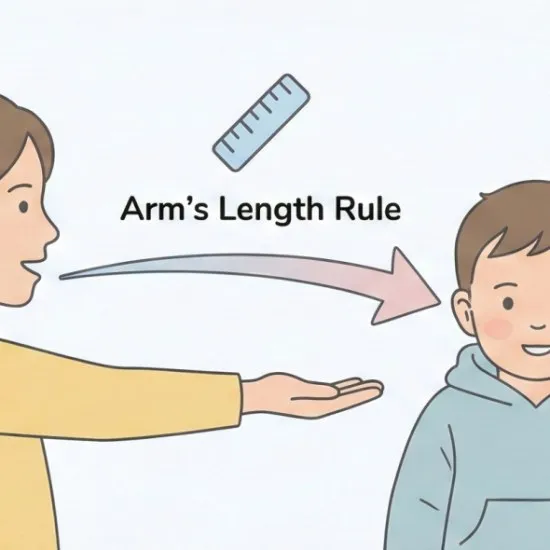
You don't need a meter. Stand an arm's length from your child and speak normally. If you have to raise your voice to be heard, the level is likely past 85 dB and protection should go on. It's the same check staff use at events.
Hidden hearing loss is real. Loud noise can damage the connections between the ear and the brain even when the hair cells survive. A child can pass a standard beep test and still struggle to follow speech in a noisy classroom years later. There's no cure for it — only prevention.
Sensory processing and autism: a portable quiet
For many children with sensory processing differences or autism, noise isn't just annoying — it can be painful, and a loud classroom, mall or event can tip the nervous system into fight-or-flight.
Earmuffs work like a dimmer switch: by softening the background layer — HVAC hum, distant chatter, traffic — they help a child settle and stay present. Three things make that work:
- Comfort over maximum dB. A soft, lower-clamp muff a child tolerates beats a stiff high-rated one they refuse.
- A design they'll wear. SafeMuff offers neutral colourways for sensory-sensitive kids and custom water-transfer graphics for retail and event lines.
- Build tolerance gradually. Start with short sessions at home in a calm room, not in the middle of a loud event.
Earmuffs reduce noise exposure; they're a comfort and protection tool, not a medical treatment.
Common loud events and where to stand
These three settings create most of the noise complaints. Use the quick notes for positioning, timing and when to take a quiet break.

Parades & street fairs
The noise moves with the parade. Stand a shopfront back from corners where units bunch up, and stay off to the side of PA horns rather than in front.

Music festivals
It's the duration as much as the volume. The cleaner spot is usually just behind the front-of-house sound desk; keep the cushions clean so dust and sweat do not break the seal.
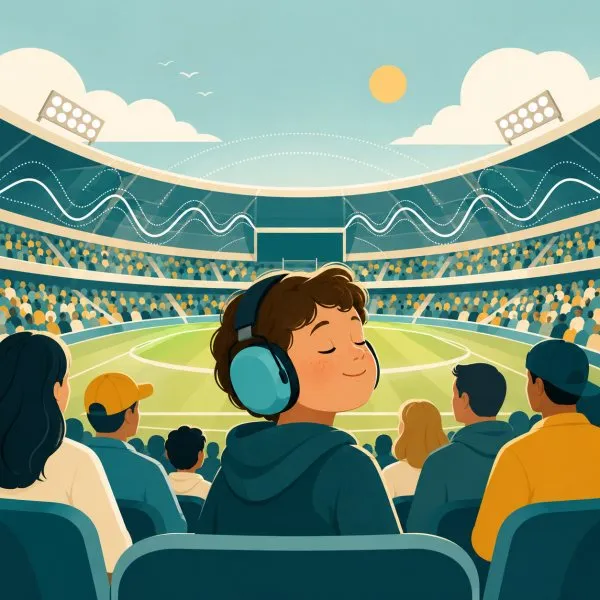
Stadium games
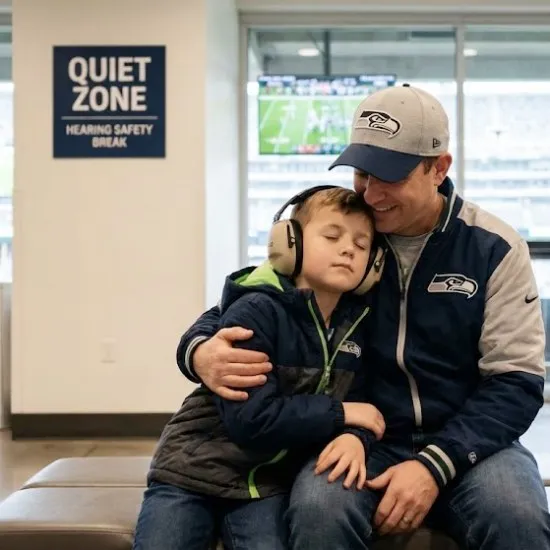
Concourses are quieter than the bowl, so take a short reset each quarter or inning. For sudden goal horns and buzzers, keep protection on rather than reacting after.
Care that keeps the seal working
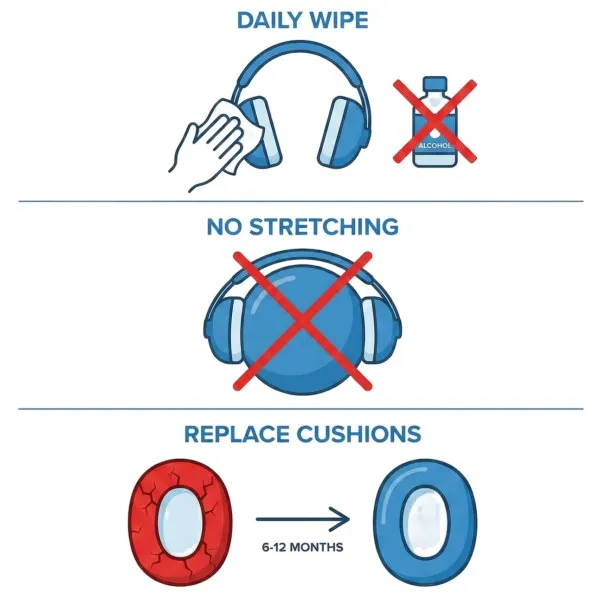
- Wipe cushions with non-alcohol wipes. Sweat and skin oils harden the cushion over time and break the seal.
- Don't store them stretched. Left pulled over a helmet or a wide object, the headband loses the tension that creates the clamp.
- Replace cushions when they crack or stiffen — usually every 6–12 months of regular use.
For schools, clinics and events
Before ordering kids' earmuffs in bulk
If you are choosing earmuffs for a class, clinic or event, start with the details that decide whether children will actually wear them:
- Who will use them — preschoolers, older kids, sensory rooms, clinics, stadium days, fireworks or travel.
- What fit matters most — lighter clamp, soft cushions, mixed sizes, easy cleaning or colours children are happy to pick up.
- Which documents you need — CPC, EN 71-3 and, if you sell them as hearing protection, EN 352-1 support.
- The basics for quoting — quantity, colour or logo needs, delivery date and where samples should be sent.
Before buying for the whole group, test a few samples on real children. If the pair feels tight, slips, or looks too industrial, it may stay in the box.
Request samplesRelated SafeMuff resources
FAQ
What NRR or SNR is best for kids?
A practical band of NRR 22–27 (about SNR 25–30) suits most kids. Very high ratings (NRR 30+) are heavier and can block speech, so a comfortable fit a child keeps on protects more than a high number they keep removing.
How do I know if a venue is too loud for my child?
Use the arm's-length test. If you have to raise your voice to be heard by your child standing an arm's length away, the level is likely above 85 dB and protection should go on.
Can toddlers wear earplugs instead of earmuffs?
Generally not recommended. Plugs are a choking hazard for toddlers and are hard to insert for the rated protection. Earmuffs are the safer default for children under five.
Are noise-cancelling headphones the same as safety earmuffs?
No. Active noise-cancelling headphones reduce steady low-frequency hum, like an aircraft engine, but are not rated (NRR/SNR) for sudden high-decibel impacts such as fireworks or drum hits. Use certified passive earmuffs for protection.
Do earmuffs help with autism and sensory overload?
They can. By reducing chaotic background noise, earmuffs act as a sensory shield that helps a child self-regulate and stay present. Comfort and a design they will wear matter more than the highest rating.
Can you make custom or branded kids' earmuffs for a school or clinic?
Yes. SafeMuff makes kids' earmuffs to order with custom colours, graphics, logo printing and packaging, and supplies EN 71-3, CPC and EN 352-1 documentation. Orders can start from samples, with custom runs typically from MOQ 500.
Source kids' earmuffs your buyers can trust
Tell us the age range, channel, noise environment and quantity. SafeMuff will match models, ratings and documentation, then send samples before a bulk or private-label run.
Request samples